 Japan Rail Pass NowAustralia's No.1 Choice
1300 635 500Mon-Fri, AEST
Buy Now
Japan Rail Pass NowAustralia's No.1 Choice
Kamakura was the seat of government from 1185 to 1333, when the shogunate ruled from here rather than Kyoto. What survives is a compact town of temples and shrines held in a bowl of wooded hills, with a beach along the open front. It is an hour from Tokyo and it feels considerably further.
Of all the Tokyo day trips, this is the one most first-time visitors find easiest, because everything is close together and much of it is walkable or reachable on a single small railway.
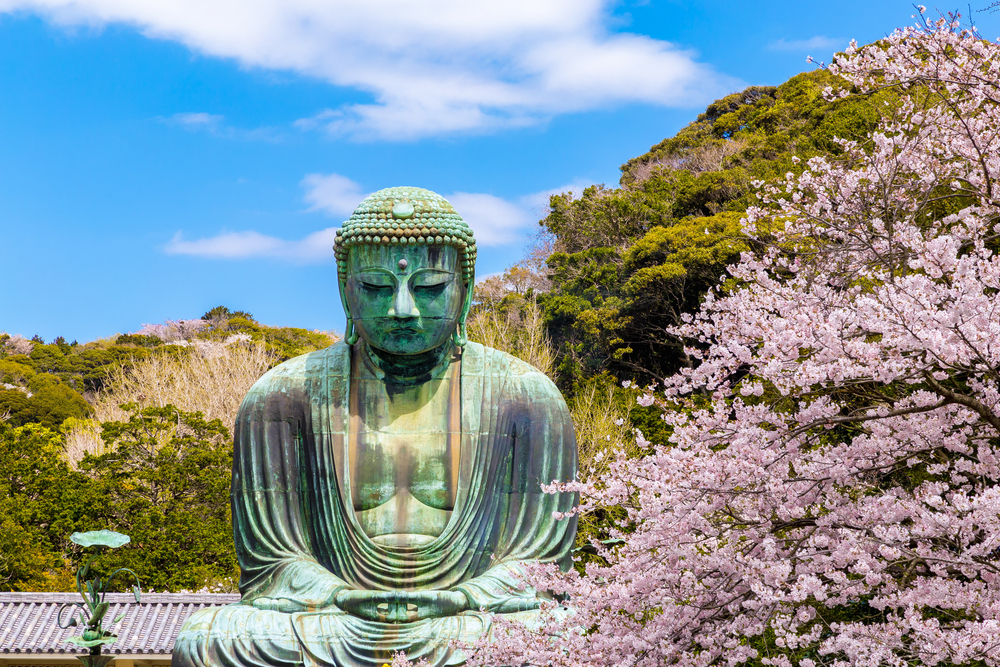
The bronze Amida Buddha at Kotoku-in stands about 11.4 metres and dates from 1252. It originally sat inside a hall, which was destroyed by storms twice and finally by a tsunami in 1498. Nobody rebuilt it, so the Buddha has sat in the open ever since, which is why it looks the way it does.
For a small extra fee you can go inside the statue and see the bronze casting technique from within, which is more interesting than it sounds.
Hasedera, a short walk from the Great Buddha, is built on a hillside with a view over the bay, and its hydrangea path in June draws large crowds. It holds an eleven-headed Kannon statue over nine metres tall.
Tsurugaoka Hachimangu is the central shrine, approached along a long avenue from the sea, and it is the ceremonial heart of the old capital.
Hokokuji is the bamboo temple, much smaller and calmer than Arashiyama in Kyoto, with a tea house where you can sit among the stems with a bowl of matcha. Engakuji and Kenchoji, near Kita-Kamakura station, are major Zen monasteries and are usually quieter than the sights nearer the beach.

Komachi-dori, the main shopping street running from the station to Tsurugaoka Hachimangu, is lined with snack stalls and small restaurants and is the easiest place to graze. Purple sweet potato from Kyushu turns up in everything here, from soft serve to tarts.
Shirasu, tiny whitebait caught off the Shonan coast, is the local speciality. It is served raw when in season, which runs roughly March to December with a closed period in winter, or boiled, piled over rice as a shirasu-don. Several restaurants along the coast at Enoshima specialise in it.
Shojin ryori, Buddhist vegetarian cuisine, is served at a handful of temples and restaurants, which makes sense in a town with this many monasteries. Kamakura vegetables are a local heritage growing tradition and appear on menus around Komachi.
The island at the end of the Enoden line is a hill rising out of the sea, connected by a bridge and covered in shrine buildings, gardens and stairways. Escalators run up the steep sections for a small fee, which most people are glad of.
Enoshima Shrine is spread across three sites on the island and dedicated to Benzaiten, goddess of music and entertainment. The Sea Candle observation tower gives a view back to the mainland and, on clear days, to Mount Fuji. The Iwaya Caves at the far end are sea caves cut into the rock and lit for visitors.
The island is busiest in summer. Winter afternoons, with Fuji visible across the water and the light going pink, are the best time to be there.
The Daibutsu hiking trail runs through the hills between Kita-Kamakura and the Great Buddha, taking around an hour and a half. It is an easy walk through forest that most visitors do not know exists.
The Enoden, a small single-track railway, runs from Kamakura along the coast to Enoshima, passing so close to houses in places that you could touch them. The level crossing at Kamakurakokomae, with the sea behind it, is famous from anime and generally has a small crowd photographing it.
Enoshima itself is an island connected by a bridge, with a shrine, caves and a lighthouse observation tower.

Kamakura is where Zen took root in Japan, brought from China in the twelfth and thirteenth centuries under shogunate patronage. The Five Great Zen Temples, or Kamakura Gozan, were the ranked head temples of that system and several survive.
Kenchoji, founded 1253, is the oldest Zen training monastery in the country and still functions as one. Its grounds run back into the hills, and a path from the rear climbs to a viewpoint and joins the Ten’en hiking trail.
Engakuji, next to Kita-Kamakura station, was founded in 1282 to honour the dead of both sides in the Mongol invasions. Its bell is the largest in Kamakura and a national treasure.
Hokokuji is the small one people remember, with a grove of maybe two thousand bamboo stems and a tea house at the back where you sit with matcha among them. It is far calmer than the Arashiyama grove in Kyoto and, for most people, better.
Meigetsuin is the hydrangea temple, spectacular in June and heaving with it. Its round window looking onto the rear garden is one of the most photographed frames in Japan.
Most visitors day trip from Tokyo. Staying gives you the temples at opening and the beach in the evening, and Kamakura has a decent spread of small hotels and guesthouses near the station and along the coast at Shichirigahama and Enoshima.
Summer weekends are the exception to book early, when the beaches fill with people escaping the city.
Kamakura sits in a bowl of wooded hills, and three old trails cross them. The Daibutsu trail runs from Kita-Kamakura to the Great Buddha in about 90 minutes. The Ten’en trail is longer and quieter, climbing from Kenchoji along the ridge. The Gionyama trail is the shortest at around 30 minutes.
These are proper paths through forest rather than paved walkways, with roots and mud after rain, but none is difficult. They are the best way to understand the town’s defensive geography, since the hills and the sea are exactly why the shogunate chose the site.
Autumn is the best combination of comfort and colour, with maples peaking late November and early December. June brings hydrangeas and the largest crowds of the year at Meigetsuin and Hasedera. Summer means beach traffic at weekends, and winter is clear, cold and quiet, with the added benefit of Mount Fuji frequently visible from the coast.
The JR Yokosuka line runs direct from Tokyo Station to Kamakura in under an hour. From Shinjuku, the Shonan-Shinjuku line takes a similar time.
Once there, the Enoden handles the coastal sights and Kita-Kamakura is one stop north on the JR line. The central temples are walkable. Bicycles are available near the station and work well for the flatter parts.
One practical note. Kamakura is small and the sights are spread between three stations, so plan your day around the geography rather than a list. Kita-Kamakura for the Zen temples, central Kamakura for the shrine and Komachi, and the Enoden line for the Great Buddha, Hasedera and the coast. Doing them in that order means you finish at the sea with the afternoon light, which is the right way round.
A full day is right. Half a day covers the Great Buddha and Hasedera but misses the Zen temples and the coast, which are what give the place its range.
June brings hydrangeas and the largest crowds of the year at Hasedera and Meigetsuin. Autumn is quieter and just as good.
It is the easiest of the major options, under an hour each way, with temples, a Zen circuit, a hiking trail and a beach all within a compact area.
About 11.4 metres of bronze, cast in 1252. It has stood outdoors since a tsunami destroyed its hall in 1498.
A small coastal railway running from Kamakura to Enoshima, passing between houses and along the shoreline. It is an attraction in its own right.
Autumn for colour and comfort. June for hydrangeas, though that is also the busiest. Summer weekends are crowded because of the beach.
Yes, easily, they are connected by the Enoden in about 25 minutes and make a natural full day together.

Ensure you get the most out of your trip to the land of the rising sun with our comprehensive 249-page Japan Travel Guide.