 Japan Rail Pass NowAustralia's No.1 Choice
1300 635 500Mon-Fri, AEST
Buy Now
Japan Rail Pass NowAustralia's No.1 Choice
Kanazawa gets described as a small Kyoto, which undersells it. The city was the seat of the Maeda clan, the wealthiest feudal domain in Japan after the shogunate itself, and it spent that wealth on gardens, crafts and tea houses rather than on war. It escaped bombing in the Second World War, so the samurai and geisha districts are original rather than reconstructed.
The Hokuriku Shinkansen put it within about two and a half hours of Tokyo, which transformed it from an awkward detour into an easy addition. It is still nowhere near as crowded as Kyoto, and for a lot of travellers it becomes the surprise favourite of the trip.
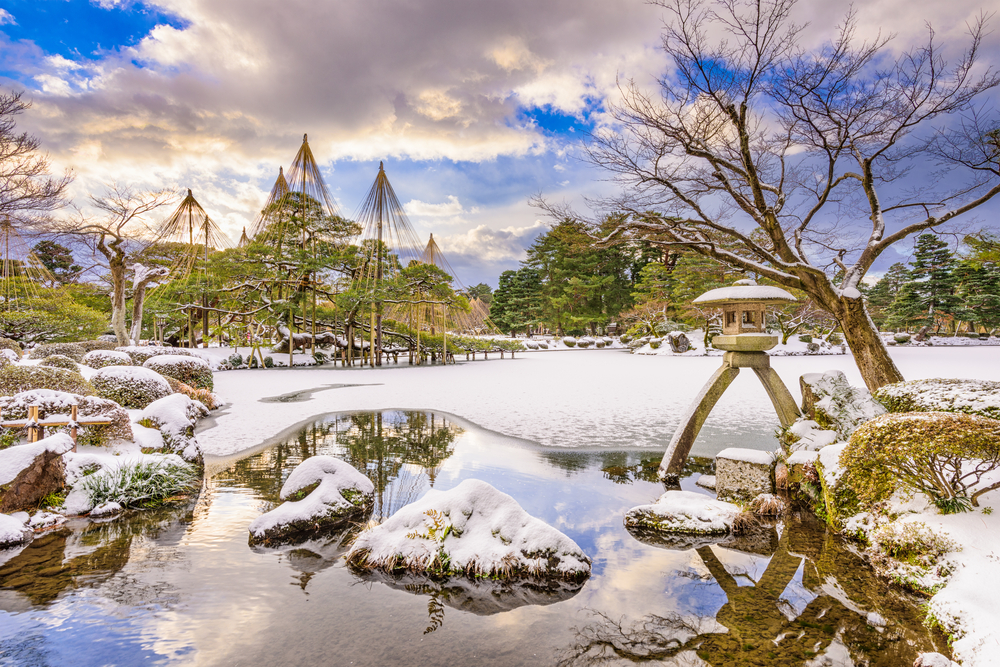
Kenrokuen is counted among the three great gardens of Japan, alongside Korakuen in Okayama and Kairakuen in Mito. The name means garden of the six qualities, referring to attributes that were held to be difficult to combine: spaciousness and seclusion, artifice and antiquity, water and views.
It was developed over roughly two centuries by successive Maeda lords, and it works in every season, which is unusual. Plum and cherry in spring, deep green and irises in summer, maples in autumn, and in winter the yukitsuri, conical arrangements of rope that support the pine branches under snow and have become the city’s emblem.
Go at opening. The garden admits visitors free in the early morning before official hours in most seasons, which is both a bargain and by far the best time to be there.
Kanazawa has three preserved tea house districts, where geisha entertained and in some cases still do. The wooden buildings with their fine slatted facades are original, which is what separates this from most Japanese heritage streets.
Higashi Chaya is the largest and best known, a compact grid of two storey tea houses now holding cafes, gold leaf shops and a couple of houses open to the public. Shima and Kaikaro can both be entered and are worth it to see how the interiors worked.
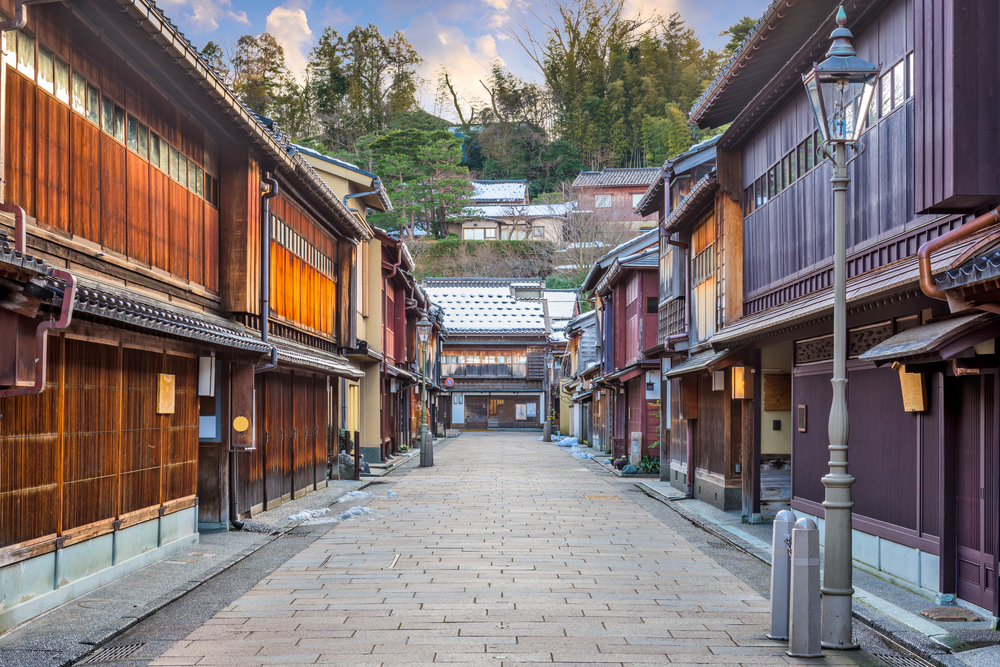
Nishi Chaya is much smaller and quieter, on the other side of the river. Kazuemachi runs along the Asano river and is the most atmospheric at dusk, when the lanterns come on and the crowds have gone.
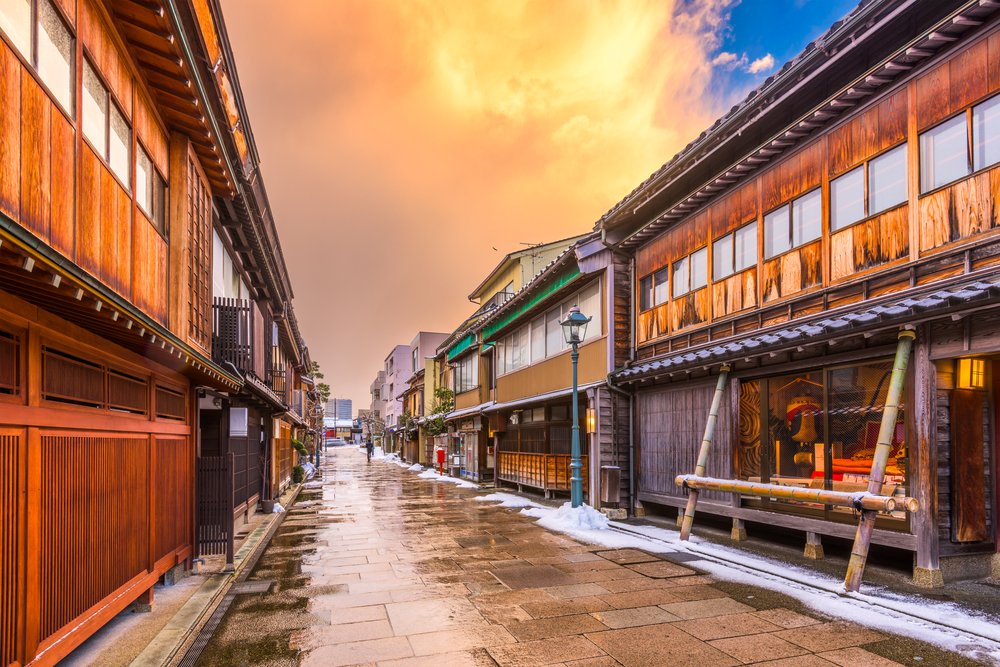
Nagamachi is the samurai quarter, a warren of earthen walled lanes below the castle where middle ranking retainers lived. The Nomura family residence is open and has a small but exceptional garden crammed into a courtyard. In winter the walls are wrapped in straw matting against the frost, which is a striking thing to walk through.
Kanazawa Castle sits beside Kenrokuen and has been progressively reconstructed using traditional joinery, with no nails in the main structures. The grounds are free and the reconstruction work is genuinely interesting if you have any interest in how these buildings went together.

Kanazawa produces around 99 per cent of Japan’s gold leaf, and it is everywhere here, on lacquerware, on ceramics, and, inevitably, on soft serve ice cream. Several workshops run short sessions where you can apply leaf to a small object yourself.
The city is also known for Kutani porcelain, Kaga yuzen silk dyeing and lacquerware, and the crafts are still working trades rather than museum pieces. The 21st Century Museum of Contemporary Art is the modern counterweight, a circular glass building with free outdoor works including Leandro Erlich’s swimming pool, and it is one of the best contemporary galleries in the country.
Omicho Market has been the city’s kitchen for close to three hundred years. Kanazawa sits on the Sea of Japan and the seafood is exceptional, particularly snow crab in winter and sweet shrimp year round. Several stalls will serve you a kaisendon, a bowl of rice under raw seafood, at a counter on the spot.
The station area is the practical choice, with the largest concentration of hotels and the Tsuzumi-mon gate and glass dome making it one of the more striking station forecourts in Japan. It is a fifteen minute bus ride from the main sights.
Korinbo and Katamachi sit between the castle and the river and put you closer to the nightlife and to Kenrokuen. For atmosphere, a handful of ryokan and converted machiya operate in and around the Higashi Chaya district, which means stepping out into the lantern lit lanes after the crowds have gone.
Kanazawa eats extremely well for a city its size, and the Sea of Japan is the reason.
Kaisendon, a bowl of rice under raw seafood, is the signature dish and Omicho Market is where to eat it. Nodoguro, blackthroat seaperch, is the prized local fish, rich and best grilled. Kanou crab comes into season in November and runs through winter, and the male and female crabs are sold and priced quite differently.
Jibuni is the local classic, duck dusted in flour and simmered with wheat gluten and vegetables, thicker and more savoury than most Japanese stews. Kaga vegetables are a set of heritage varieties grown only in the area and appear across menus.
Kanazawa also has a serious sake and confectionery tradition, the latter because the tea ceremony was central to Maeda court culture. Wagashi shops here are unusually good.
The city’s crafts are living trades and many workshops run short sessions for visitors.
Gold leaf application is the most popular, usually an hour spent decorating a small box or a pair of chopsticks. Kaga yuzen silk dyeing workshops let you paint a handkerchief in the traditional style, and Kutani porcelain studios run painting sessions on pre-fired pieces.
The Kanazawa Yasue Gold Leaf Museum and the Kaga Yuzen Kaikan both cover the history if you would rather watch than make.
Two loop buses circle the main sights from the station, one clockwise and one anticlockwise, at a flat fare per ride. A day pass covers both and pays for itself in three trips.
The city is also compact enough to walk. Kenrokuen to Nagamachi is about fifteen minutes, Kenrokuen to Higashi Chaya about twenty, and the walk between them takes you along the Asano river which is pleasant in itself. Bicycles are available through a public share scheme with docking stations across the centre.
Two days is right. One covers Kenrokuen, the castle and Nagamachi, the other the chaya districts, the market and the contemporary art museum.
A single day is possible and many people do it as a stop between Tokyo and Kyoto, but it is a shame. Kanazawa is at its best early and late, and the chaya districts at dusk are the reason to stay the night.
The Hokuriku Shinkansen runs from Tokyo in around two and a half hours. From Kyoto or Osaka the Thunderbird limited express takes a little over two hours. Kanazawa sits neatly between Tokyo and Osaka if you route yourself up the Sea of Japan coast rather than along the Tokaido, which makes it easy to add without backtracking.
The city itself is compact. Two loop bus routes circle the main sights from the station, and a flat fare covers each ride. Walking between Kenrokuen, Nagamachi and Higashi Chaya is entirely feasible and pleasant, roughly twenty minutes between each.
Shirakawago, the UNESCO village of steep thatched farmhouses, is about ninety minutes by bus and is one of the most photographed places in Japan, particularly under snow. Takayama lies beyond it in the mountains, and the two combine into a natural route across the Alps. Our Takayama travel guide covers that end.
Kaga Onsen is a cluster of hot spring towns half an hour south, and Noto Peninsula runs north into rugged coastline and fishing villages.
Yes, particularly if Kyoto’s crowds concern you. The samurai and geisha districts here are original rather than rebuilt, and visitor numbers are a fraction of Kyoto’s.
Two days covers it comfortably. One day is possible as a stop between Tokyo and Kyoto but misses the early mornings and evenings that make the city.
The Hokuriku Shinkansen takes around two and a half hours direct.
Every season works, which is unusual. Winter is the signature look, with snow on Kenrokuen and crab in season, though it is also the wettest and greyest time.
Yes, around ninety minutes each way by bus. Reserve seats in advance in autumn and winter, when it is busiest.

Ensure you get the most out of your trip to the land of the rising sun with our comprehensive 249-page Japan Travel Guide.